AI Agents Are Getting a Hardware Permission Layer
Anthropic's Model Hardware Standard preview shows that agents controlling real equipment need more than tool access: they need safety limits, supervision, and auditable hardware interfaces.
Counting reads...
AI Agents Are Getting a Hardware Permission Layer
Short Summary
AI agents are moving from software workflows into physical environments.
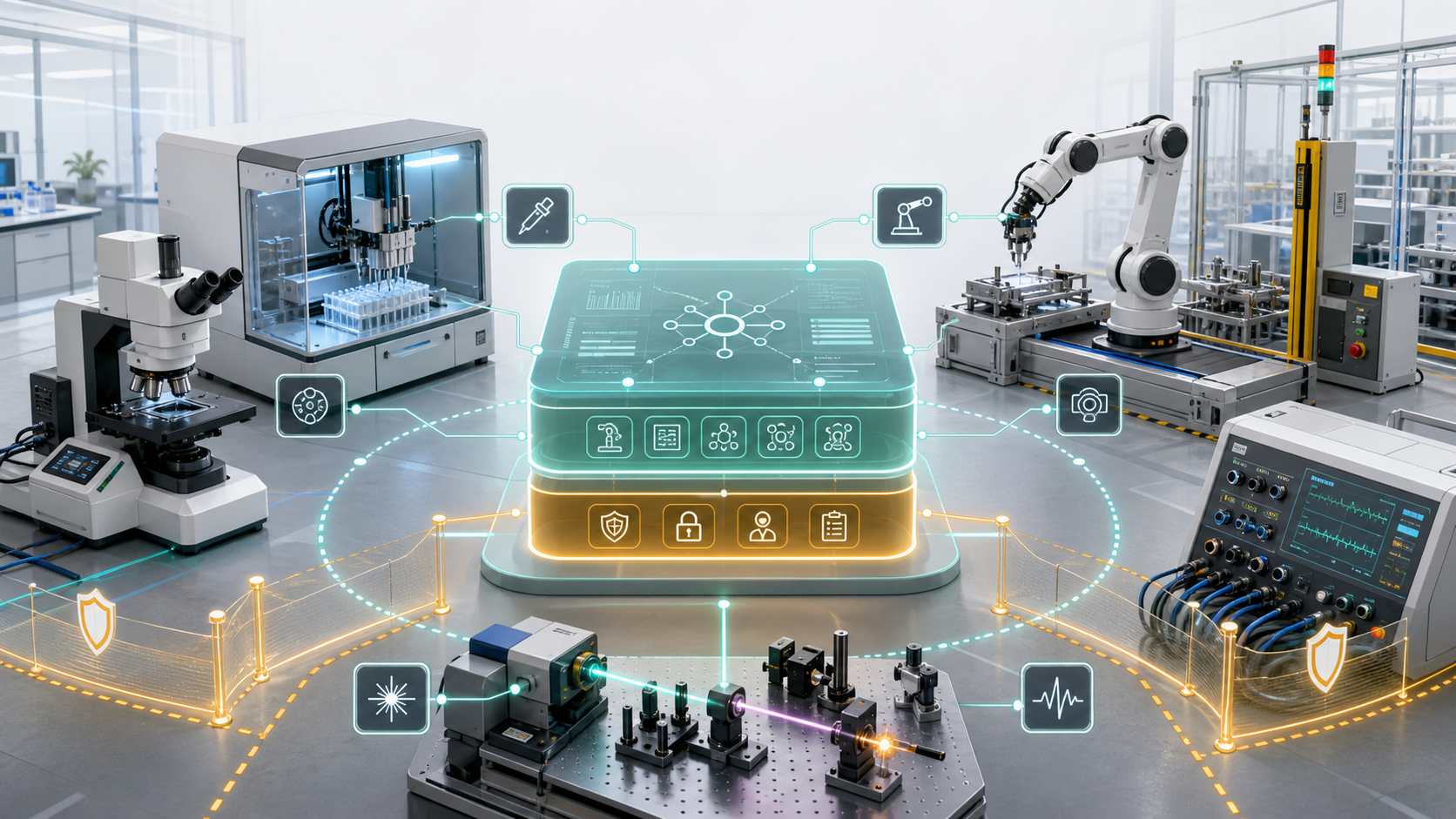
Anthropic opened a research preview of the Model Hardware Standard on August 27, 2026. The goal is to give AI agents a shared way to discover, monitor, and operate programmable lab and manufacturing equipment such as microscopes, liquid handlers, robotic arms, and laser calibration setups.
That is not just another integration story. Once an agent can move hardware, safety limits, permissions, logs, and human supervision become part of the product interface.
What Happened
Anthropic describes MHS as a shared specification for agents operating physical devices. It began with HHMI Janelia Research Campus and is now being tested with partners across science, robotics, electronics, and manufacturing before a planned open-source release.
The core idea is a standardized driver layer. Instead of each lab or factory building bespoke integrations for every instrument, an MHS driver can expose simple primitives such as reading device state or writing a controlled parameter. The driver can also describe device characteristics, adjustable settings, and enforced safety limits in a form an agent can use.
Anthropic says MHS is model-agnostic and can be accessed through standard mechanisms including the Model Context Protocol, command-line interfaces, and APIs. Reuters summarized the same direction as a move toward agents operating multiple pieces of physical equipment in tandem.
The important caveat is that this is still a limited research preview. Anthropic explicitly says expert oversight remains necessary because language models have limited spatial and physical reasoning.
Why It Matters
Software agents already raise questions about tool permissions. Hardware agents raise the stakes because a bad action can damage equipment, spoil samples, injure people, or create regulated safety obligations.
That makes the interface design more important than the demo. A useful hardware-agent standard should answer practical questions before production use:
- What actions can the agent take?
- Which parameters are read-only, bounded, or blocked?
- Who can approve a risky operation?
- What gets logged when the agent changes hardware state?
- Can the system stop safely if the model, driver, network, or sensor feed fails?
This also connects to the wider MCP ecosystem. MCP tooling already treats tool access as a trust-and-safety issue and recommends visible user control around tool invocation. In a physical setting, that same principle needs stronger defaults: interlocks, local emergency stops, device-level constraints, and audit trails that do not depend on the model behaving well.
Practical Impact
AI teams should not evaluate MHS-style systems only as automation accelerators. They should evaluate them as safety-critical integration layers.
For research labs, the near-term opportunity is faster orchestration of repetitive experiments and better reproducibility. The risk is that tacit instrument knowledge gets compressed into driver metadata without enough validation.
For manufacturers, the opportunity is a common agent-facing interface across machines. The risk is unclear responsibility when a model-generated plan, driver file, or operator approval changes a physical process.
For European deployments, timing matters. Regulation (EU) 2023/1230 on machinery applies from January 20, 2027 and explicitly addresses software ensuring safety functions and machine-learning-based safety components. That does not automatically make every MHS driver a regulated safety component, but it does mean teams should classify whether their agent interface is only operational control or part of a safety function.
Watch Points
- Whether MHS publishes concrete driver schemas, safety-limit models, and audit requirements.
- Whether open-source release timing depends on external safety evaluations.
- Whether labs can validate natural-language device descriptions against real hardware behavior.
- Whether hardware vendors expose safe defaults rather than only broad remote-control APIs.
- Whether regulators treat agent-facing hardware descriptions as safety documentation.
Final Take
The next agent platform boundary is physical.
If AI agents are going to run microscopes, robot arms, liquid handlers, and manufacturing tools, the useful standard is not only “how does the model connect?” It is “what is the model allowed to do, who approved it, and what proves the system stayed inside the limits?”
That is where MHS becomes worth watching.
Sources
- “Previewing the Model Hardware Standard” - https://www.anthropic.com/news/model-hardware-standard-research-preview
- “Model Hardware Standard” - https://modelhardwarestandard.com/
- “The 2026-07-28 Specification” - https://blog.modelcontextprotocol.io/posts/2026-07-28/
- “Tools - Model Context Protocol” - https://modelcontextprotocol.io/specification/2025-06-18/server/tools
- “Anthropic unveils new framework allowing AI agents to operate physical devices” - https://www.investing.com/news/stock-market-news/anthropic-unveils-new-framework-allowing-ai-agents-to-operate-physical-devices-4880003
- “Regulation (EU) 2023/1230 on machinery” - https://eur-lex.europa.eu/eli/reg/2023/1230/oj