Microduck Wasn't Built by NVIDIA—But NVIDIA Taught It to Move
Pollen Robotics built the $399 open-source Microduck. NVIDIA's simulation and training stack shows why the small robot matters for physical AI.
Counting reads...
Microduck Wasn’t Built by NVIDIA—But NVIDIA Taught It to Move
Short Summary
Microduck stole the show at NVIDIA’s GTC Berlin keynote: four tiny robots walked, sat, stood up and took a theatrical nap around CEO Jensen Huang. The demonstration made it easy to assume that Microduck is an NVIDIA robot.
It is not. Microduck was developed by Pollen Robotics, which has been part of Hugging Face since 2025. NVIDIA supplied the physical-AI training stack used in the new demonstration: agent-assisted planning on RTX Spark, simulation in Isaac Sim, reinforcement learning in Isaac Lab, Newton physics, cloud GPU training and local policy evaluation.
That distinction is the story. Microduck is a small, relatively affordable example of how robot makers can combine open hardware and shared policies with industrial-grade simulation infrastructure.
What Microduck Is
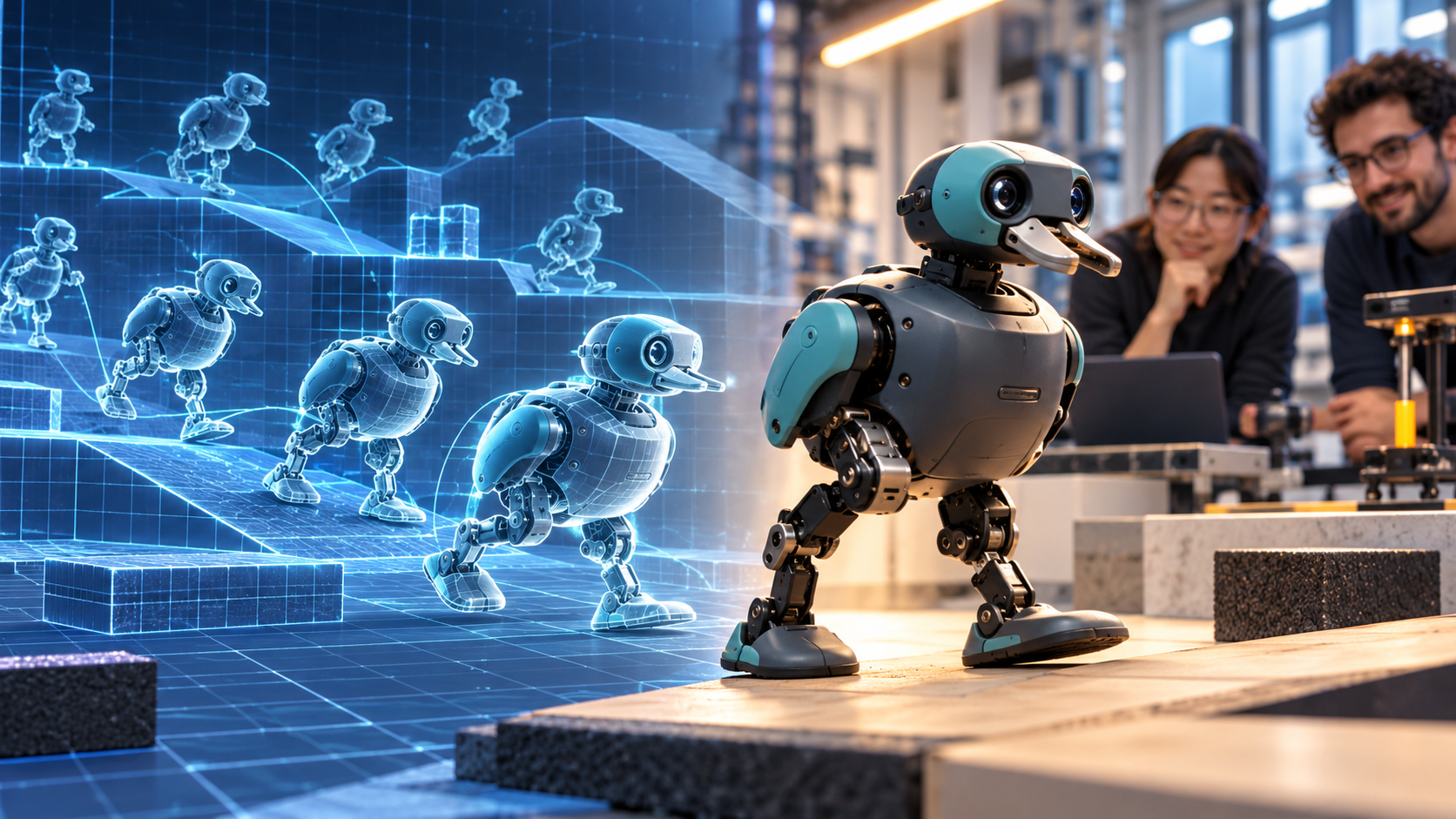
Microduck is a 25-centimeter, 780-gram biped with 15 motors. Its sensors include a wide-angle camera, a compact time-of-flight lidar unit and two inertial measurement units. An articulated beak can grasp light objects.
Pollen Robotics says the robot can walk, crouch, recover from common falls and run additional learned behaviors. It uses a Rockchip RK3566 system with an AI accelerator—not an NVIDIA processor—and comes with an open-source software stack intended for reinforcement-learning experiments.
The introductory pre-order price is $399 before taxes and shipping. First deliveries are targeted before Christmas 2026.
Where NVIDIA Fits
NVIDIA’s October 23 technical walkthrough uses Microduck as a reference platform for an end-to-end physical-AI workflow.
An AI agent on RTX Spark turns a prompt into a project plan for an obstacle course. Asset tools help create the 3D environment. Isaac Sim assembles the digital scene, while Newton models motion and contact. Isaac Lab then trains one locomotion policy across 4,096 parallel environments on an RTX PRO 6000 Blackwell workstation GPU.
The selected policy returns to RTX Spark for evaluation in simulation. Engineers measure course completion, falls, collisions and stalled runs before preparing deployment to the physical robot.
NVIDIA also highlights the hard part: simulation is not reality. Servo delays, mechanical backlash, falling battery voltage, sensor noise and ground contact all create a sim-to-real gap. Better Actuator Models and domain randomization help expose the policy to those variations before hardware deployment.
Why It Matters for Industry
Microduck is not an industrial robot. It will not move pallets, weld car bodies or inspect offshore infrastructure. Its value is as a compact, reproducible learning platform for the same workflow larger robots need.
For engineering teams, it lowers the cost of testing several important ideas:
- Parallel policy training: thousands of simulated robots can learn from different conditions without consuming physical hardware time.
- Safer failure: early policies can fall, collide and behave poorly in simulation before they reach a real machine.
- Repeatable evaluation: teams can define completion, collision and recovery metrics instead of judging a polished demo video.
- Transferable artifacts: robot descriptions, environments, policies and training recipes can be versioned and shared.
- Fleet experimentation: several affordable robots make multi-agent coordination, classroom labs and regression testing more accessible.
The larger opportunity is separation of concerns. A robot company can specialize in mechanics and product design, a compute platform can provide simulation and training, and a model hub can distribute policies and datasets.
A Practical Adoption Pattern
An industrial team should not jump directly from a successful Microduck demo to a production machine. A more credible path is staged:
- Build and validate a digital twin against measured actuator and sensor behavior.
- Define the observation space, permitted actions and reward function explicitly.
- Train across randomized but realistic operating conditions.
- Freeze a candidate policy and evaluate it on scenarios excluded from training.
- Test on hardware inside a constrained safety envelope with emergency stops and human supervision.
- Record failures, update the simulator and repeat.
- Promote a policy only with versioned evidence, rollback support and operational limits.
This loop matters more than the robot’s personality. A cute form attracts attention; a measurable sim-to-real process creates engineering value.
Limits and Open Questions
NVIDIA’s technical post stops before detailed deployment to the physical robot. The public demonstration therefore shows a compelling workflow, not proof that simulation removes the need for hardware tuning.
Microduck’s small size and low forces also make it a forgiving platform. Results will not transfer directly to heavy equipment, fast mobile robots or safety-critical systems. Those deployments need stronger validation, redundancy, operational controls and regulatory review.
There is also a product question: the long-term value depends on how complete the open-source release becomes, how easily users can reproduce training, and whether the community shares robust policies rather than isolated tricks.
Final Take
Microduck is best understood as Pollen Robotics hardware meeting NVIDIA’s physical-AI infrastructure—not as a robot developed by NVIDIA.
Its importance is not the somersault. It is the compressed development loop behind it: plan, simulate, train in parallel, evaluate, transfer, measure and iterate. If that loop becomes accessible and reproducible, a $399 duck can teach the robotics industry something serious.
Sources
- “Meet Microduck” - https://pollen-robotics.com/microduck/blog/introducing-microduck/
- “Using AI Agents to Teach Robots Like Microduck to Walk in Simulation” - https://developer.nvidia.com/blog/?p=124028
- “Train in Simulation, Deploy on a Real Robot: Microduck with Isaac Lab 3.0” - https://huggingface.co/blog/nvidia/microduck-isaac-lab-sim-to-real
- “GTC Berlin 2026: Live Updates From NVIDIA CEO Jensen Huang’s Keynote” - https://blogs.nvidia.com/blog/gtc-berlin-2026-keynote/
- “Hugging Face debuts Microduck, a $399 robot” - https://www.axios.com/2026/08/27/hugging-face-debuts-microduck-a-399-robot