Meta's New Model Launches Are About Distribution, Not Just Benchmarks
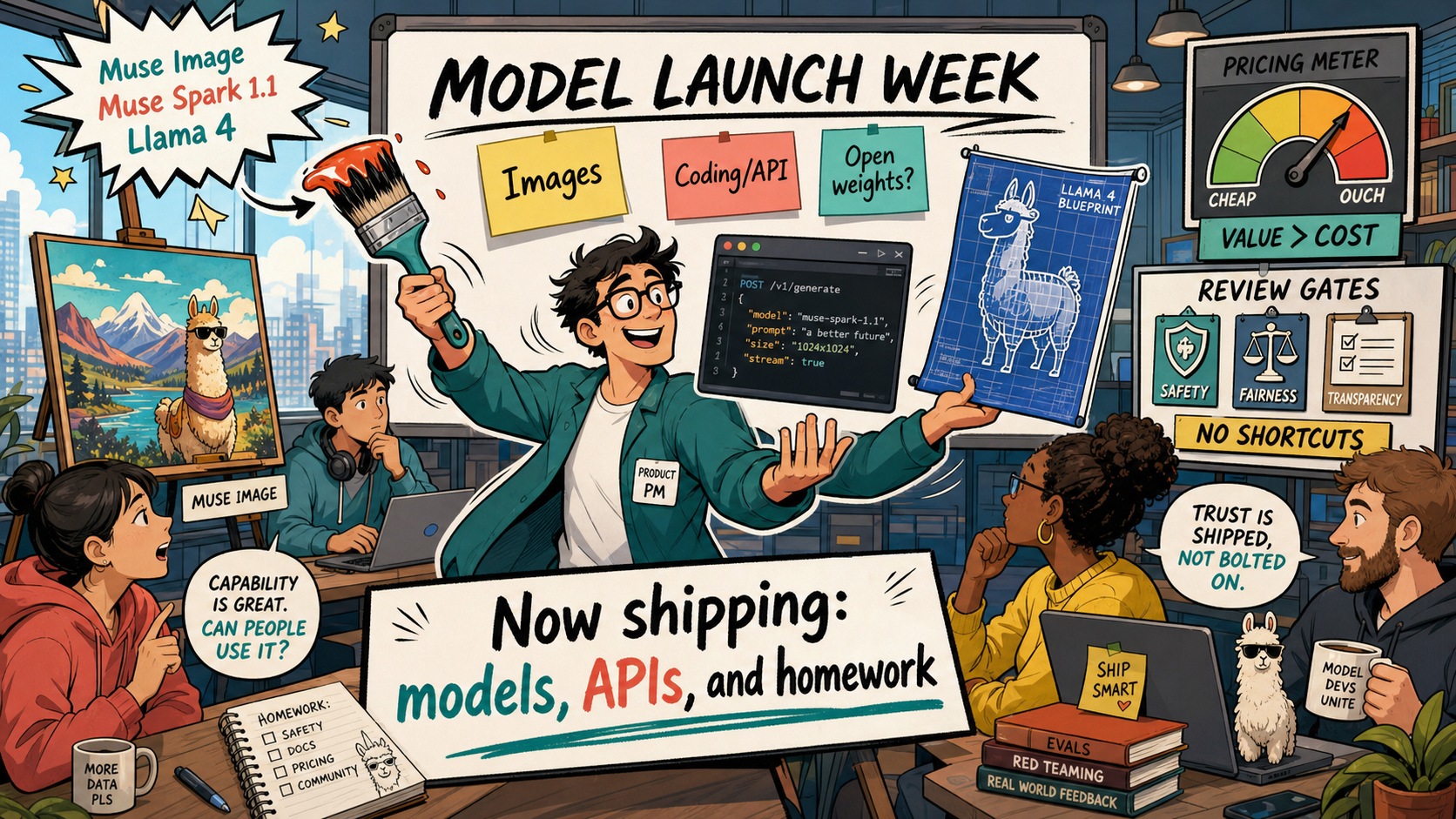
Meta's July launches around Muse Image, Muse Spark 1.1, and model API access show a practical shift from model demos toward distribution, pricing, and developer adoption.
Counting reads...
Meta’s New Model Launches Are About Distribution, Not Just Benchmarks
Short Summary
Meta is putting new AI models in front of users and developers in a more direct way. In early July, the company added AI photo-to-video features powered by Muse Image, then moved Muse Spark 1.1 into a paid developer API preview.
That matters because the story is bigger than one model launch. Meta has already been trying to reset expectations with Llama 4, including multimodal models and a very large Behemoth model still in training. The July launches show the next layer of the strategy: make models usable inside products, expose them to developers, and test whether Meta can turn open-model attention into a real platform.
The key question is not only whether Meta’s latest models are good. It is whether developers will treat Meta as dependable infrastructure when the model lineup, pricing, licensing posture, and product surfaces are all moving at once.
What Happened
Meta’s official Llama 4 announcement earlier positioned Scout and Maverick as natively multimodal models, with Behemoth described as a much larger model still in training. Meta presented the release as the start of a new era for its open model ecosystem.
In July, the company shifted from broad model positioning to more productized access. Axios reported on July 7 that Meta was rolling out AI tools that can turn photos into videos, using its Muse Image model family. Two days later, The Verge and Axios reported that Meta was opening a model API preview with Muse Spark 1.1 available to developers.
The Verge reported that Meta’s API preview is not just a free open-weights story. Developers can access Muse Spark 1.1 through paid API pricing, and Meta says broader model access is planned. That puts Meta closer to the familiar cloud-model pattern: quick API access, usage-based pricing, and a distribution channel where developers can test the model without hosting it themselves.
Why It Matters
For years, Meta’s AI identity has been tied to open releases. That approach helped Llama become a default option for teams that wanted more control over deployment, fine-tuning, and data handling.
But open weights are not the whole market. Many teams want an API, stable docs, predictable pricing, safety controls, and a roadmap they can build against. Meta’s new launch pattern suggests it wants both sides: the ecosystem pull of Llama and the monetizable distribution of hosted model access.
That is strategically important because model quality is no longer the only adoption hurdle. Developers also choose based on latency, cost, reliability, licensing clarity, eval results, safety filters, support, and whether a provider will keep the product surface stable long enough to justify integration work.
Key Details
- Meta’s Llama 4 launch framed Scout and Maverick as natively multimodal models.
- Meta described Behemoth as a much larger model still in training, not a finished general release.
- Axios reported that Meta’s July photo-to-video features use the Muse Image model family.
- The Verge reported that Meta’s model API preview includes Muse Spark 1.1 with paid access.
- Axios reported that Meta wants the API to make its models easier for developers to test and adopt.
- The launch pattern points toward a hybrid strategy: open-model ecosystem, product features, and hosted API distribution.
Impact For Developers And Enterprises
For developers, the practical signal is that Meta may become easier to evaluate through hosted access. That can reduce the first step from “download, host, tune, and benchmark” to “call an API and compare results.” It is a different adoption funnel.
For enterprise teams, this is worth watching but not yet a simple migration story. A model API can speed proof-of-concepts, but production adoption still needs procurement, data-handling review, auditability, rate-limit clarity, uptime expectations, and evidence that the model behaves well on the company’s real tasks.
Teams should test Meta’s new access points against concrete workloads:
- image and video workflows where creative control matters
- code-generation or developer-tool tasks where Muse Spark is relevant
- retrieval and agent workflows that need predictable latency
- cost-sensitive applications where self-hosting Llama may still be better
- regulated use cases where licensing and logging details matter
The useful comparison is not “Meta versus everyone” in the abstract. It is “which Meta access path fits this workload: open weights, product feature, or hosted API?”
Risks Or Limitations
There are several caveats.
First, hosted API access can pull Meta into the same expectations that users have for other model providers: reliability, support, roadmap clarity, and billing discipline. That is a different business than publishing model weights.
Second, the July launches are early signals. Developers still need stable documentation, repeatable evaluations, and clearer model availability before treating the API as a long-term platform commitment.
Third, AI media tools carry their own governance issues. Photo-to-video generation can be useful for creativity, but it also raises questions about disclosure, consent, misuse controls, and provenance.
Finally, Meta’s model strategy may be harder to read because it spans open releases, social products, creative tools, research, and paid APIs. That breadth is a strength only if the developer experience becomes coherent.
Final Take
Meta’s latest launches are not just a model-news footnote. They show the company trying to connect three layers: the Llama ecosystem, consumer-facing AI features, and paid developer access.
If Meta gets that distribution layer right, it can turn model attention into platform adoption. If it does not, the launches may remain impressive demos that developers test once and then file under “interesting, but not yet infrastructure.”
Sources
- “The Llama 4 herd: The beginning of a new era of natively multimodal AI innovation” - https://ai.meta.com/blog/llama-4-multimodal-intelligence/
- “Meta rolls out AI tool that turns photos into videos” - https://www.axios.com/2026/07/07/meta-ai-photo-video-muse-image
- “Meta wants developers to pay for its AI models” - https://www.theverge.com/ai-artificial-intelligence/963193/meta-muse-spark-model-api
- “Meta aims to ignite AI developer ecosystem with new model access” - https://www.axios.com/2026/07/09/meta-ai-muse-spark-api-developers