GPT-5.6 Ultra Mode Makes Agents The Real Feature
OpenAI's GPT-5.6 preview adds max reasoning effort and an ultra mode that uses subagents, making orchestration the most important product signal.
Counting reads...
GPT-5.6 Ultra Mode Makes Agents The Real Feature
Short Summary
OpenAI’s GPT-5.6 preview is not just another model bump. The most interesting product signal is the new ultra mode, which OpenAI says goes beyond a single agent by using subagents to accelerate complex work.
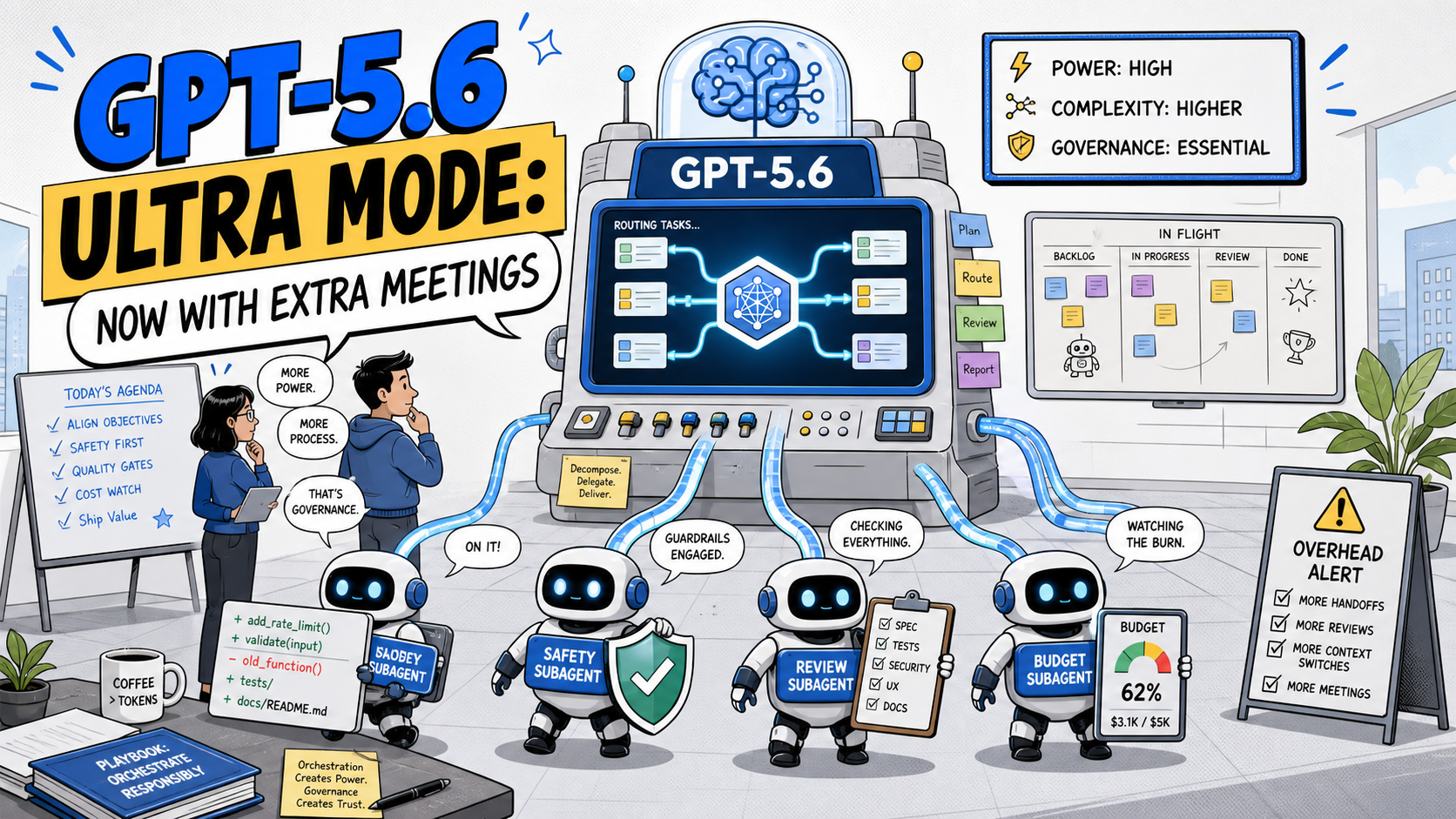
The company also introduced a new max reasoning effort for GPT-5.6 Sol. Together, those features point toward a practical shift: frontier AI products are moving from single-answer chat toward orchestrated systems that split work, reason longer, coordinate tools, and require stronger safety controls.
For developers and enterprises, the key question is not only “is GPT-5.6 smarter?” It is “when is a multi-agent workflow worth the extra cost, latency, and governance?”
What Happened
OpenAI says GPT-5.6 is a family of three models: Sol, Terra, and Luna. Sol is the flagship model, Terra is positioned as a balanced lower-cost option, and Luna is the fastest and most cost-efficient option.
The new feature worth watching is ultra mode. OpenAI describes it as a mode that uses subagents to accelerate complex work beyond what a single agent can do. The same announcement also introduces max reasoning effort, giving Sol more time to reason deeply.
OpenAI highlights coding, biology, and cybersecurity as areas where GPT-5.6 Sol shows improved agentic capabilities. The company also points readers to its GPT-5.6 Preview System Card for safety and preparedness details.
Why It Matters
Single-agent AI has a ceiling. One agent can plan, use tools, inspect files, write code, and check results, but complex work often benefits from parallel exploration: one worker investigates context, another drafts a solution, another checks assumptions, and another looks for safety or quality problems.
That is why ultra mode matters. It suggests the product boundary is shifting from model selection to workflow orchestration. The model is still important, but the user experience increasingly depends on how work is decomposed, how subagents coordinate, and how final decisions are reviewed.
For software teams, this could mean faster first drafts for hard debugging, migrations, security review, or research-heavy implementation. For enterprises, it also means more moving parts to govern: tool access, audit logs, data exposure, cost controls, and human approval.
Key Details
- GPT-5.6 Sol is positioned as OpenAI’s strongest model in the preview.
- Terra is described as a balanced model for everyday work.
- Luna is described as the fastest and lowest-cost model in the family.
maxreasoning effort gives Sol more time for deep reasoning.ultramode uses subagents for complex work that exceeds a single-agent workflow.- OpenAI says the preview includes stronger safeguards and a phased release.
- The system card treats GPT-5.6 as High capability for cybersecurity and biological and chemical risk, while saying it does not reach the High threshold for AI self-improvement.
Impact For Developers And Enterprises
For developers, GPT-5.6’s new modes should be tested on tasks where orchestration actually matters. Good candidates include messy codebase investigations, multi-file refactors, long bug hunts, security triage, and technical research.
For simpler tasks, ultra mode may be unnecessary. A cheaper or faster model may be enough for summarization, simple edits, basic QA, or routine drafting. The practical decision is not “always use the strongest mode.” It is “route the right task to the right level of reasoning.”
For enterprise teams, the rollout playbook should include:
- task classes where
ultramode is allowed - budget limits for long-running agent sessions
- logs for subagent activity and tool calls
- approval gates before external side effects
- evaluations on real company tasks
- fallback models for lower-risk work
The more capable the workflow, the more important the operating model becomes.
Risks Or Limitations
There are clear caveats.
First, the preview is limited. Public claims still need practical validation by teams using their own tasks, codebases, data, and review standards.
Second, multi-agent work can create polished wrongness at scale. If several subagents make the same bad assumption, the final output may look more thoroughly reasoned while still being wrong.
Third, cost and latency can rise quickly. max reasoning and subagent orchestration are useful only when the additional work changes the outcome.
Finally, safety boundaries matter more as agents become more capable. OpenAI’s system card emphasizes layered safeguards, real-time checks, monitoring, and differentiated access. Enterprise users need their own equivalent controls.
Final Take
GPT-5.6’s new feature is not just “more intelligence.” It is a stronger hint that the next AI product layer is orchestration.
The useful mental model is a small team of AI workers, not one chat box. That can be powerful, but only if teams know which work deserves that extra machinery and where human review still owns the final call.
Sources
- “Previewing GPT-5.6 Sol: a next-generation model” - https://openai.com/index/previewing-gpt-5-6-sol/
- “GPT-5.6 Preview System Card” - https://deploymentsafety.openai.com/gpt-5-6-preview
- “Our updated Preparedness Framework” - https://openai.com/index/updating-our-preparedness-framework/