The White House Frontier AI Review Turns Safety Into A Release Workflow
A confidential U.S. framework for pre-release review of advanced AI models could make model safety less like a public checklist and more like a guarded launch process.
Counting reads...
The White House Frontier AI Review Turns Safety Into A Release Workflow
Short Summary
The U.S. government is moving closer to a new kind of frontier AI oversight: not a broad public licensing regime, but a confidential pre-release review process for the most advanced models.
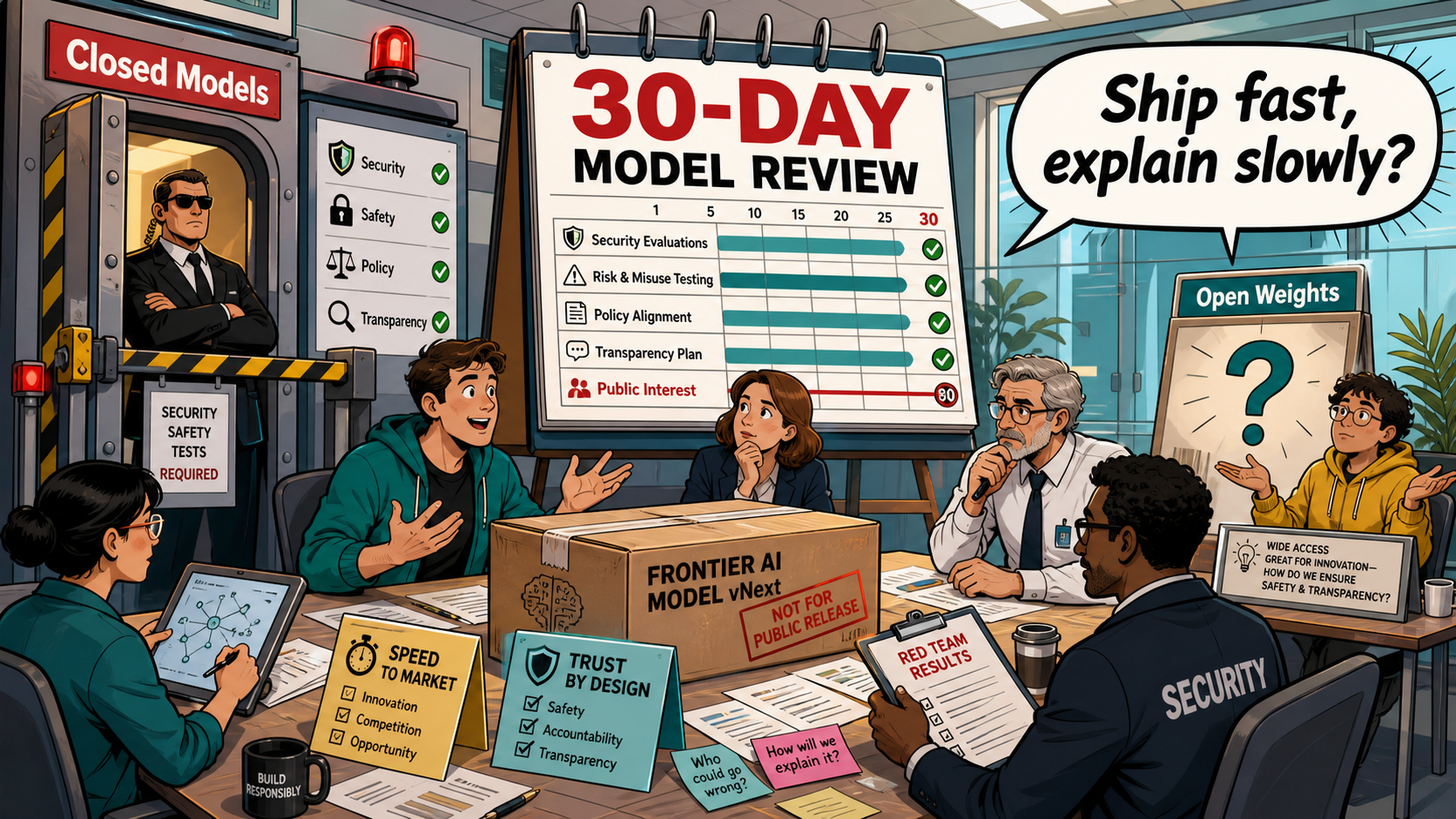
Axios reported on August 4, 2026 that the Trump administration’s AI framework would create a voluntary review process for advanced closed-source AI systems before public release, including a 30-day review window and restricted employee access during that period. Wired and The Wall Street Journal reported similar details, including that open-weight models are outside the process for now.
That distinction matters. The policy signal is not “all AI releases now need approval.” It is closer to “the most security-relevant closed models may need a guarded launch workflow before they reach the public.”
What Happened
The policy backdrop is the June 2026 executive order on advanced AI innovation and security. That order directed federal agencies to develop a classified benchmarking process for advanced cyber capabilities and a voluntary framework with AI developers for covered frontier models.
This week, reporting suggests the framework has become more concrete. Axios says the process is confidential, focused on advanced closed-source systems with possible national security implications, and encourages companies to submit models that are close to public release rather than early research versions.
Wired reported that major AI companies were invited to a private White House briefing on the framework, while critics raised concerns about transparency, fairness, and whether a secret voluntary process could favor large labs with better access to government officials.
The Wall Street Journal reported that U.S. open-weight models are exempt from government review for now, even as closed proprietary systems with state-of-the-art cyber capabilities are expected to be the main focus of the review process.
Why It Matters
Frontier model launches are becoming release-management events, not only research milestones.
The old pattern was mostly internal: train, evaluate, red-team, decide access levels, publish a blog post, and roll out through products or APIs. A 30-day government review path adds another step for models that may cross sensitive cyber or national security thresholds.
For labs, that changes planning. A model that looks ready from a product perspective may still need additional time for classified benchmarking, access controls, documentation, and government coordination. For users, it may create a clearer security signal, but only if the process produces trusted outcomes.
The open-weight exemption is equally important. Open models are central to startups, researchers, enterprise customization, and international competition. Excluding them from review preserves speed and distribution, but it also leaves unresolved questions about what happens when open-weight systems reach the same risky capabilities as closed frontier models.
Key Details
- The June executive order called for classified benchmarking to identify covered frontier models with advanced cyber capabilities.
- Current reporting says the new process is voluntary and confidential rather than a public pre-clearance regime.
- Axios reported a 30-day pre-release review period for advanced closed-source systems.
- Wired reported that the framework is being shared privately with major AI companies, drawing transparency concerns.
- The Wall Street Journal reported that U.S. open-weight models are exempt from review for now.
- The practical focus is cybersecurity and national security risk, not every generative AI product launch.
Impact For Developers And Enterprises
For developers, the immediate effect may be uneven. Most teams will not interact directly with the framework, but they may feel it through delayed model releases, staged API access, or more cautious availability of high-risk capabilities.
For enterprise buyers, this creates a new diligence question: if a vendor claims a frontier model is safe for sensitive work, what review did it undergo, and what evidence can be shared? A confidential government process may help the vendor, but customers still need usable risk documentation.
Teams evaluating frontier models should watch for:
- whether release dates shift because of pre-release review
- whether model cards and system cards explain review status
- whether cyber-capability controls differ by customer tier
- whether open-weight models receive separate safeguards
- whether voluntary review becomes a practical requirement for major labs
The governance issue is not just whether the government has a role. It is whether that role improves security without turning model access into an opaque insider process.
Risks Or Limitations
There are several caveats.
First, the framework is reported as confidential, so public understanding depends heavily on reporting and selective disclosures. That makes independent evaluation harder.
Second, a voluntary process can become quasi-mandatory if large customers, agencies, or partners treat participation as a trust signal. That may be useful, but it should be acknowledged honestly.
Third, open-weight models remain a hard problem. Keeping them outside review may protect innovation and competition, but it does not eliminate misuse risks as capabilities rise.
Finally, secrecy can cut both ways. Some cyber details may need classification, but public rules about scope, process, appeal, and accountability matter if the framework shapes market access.
Final Take
The new frontier AI review framework is best understood as a release workflow for the most sensitive model launches.
It does not appear to be a blanket AI licensing system. But it does move the center of gravity: frontier model safety is becoming part of launch operations, government relationships, and market trust.
The hard part will be making that process credible without making it invisible.
Sources
- “Scoop: Inside Trump’s AI framework” - https://www.axios.com/2026/08/04/inside-trump-ai-framework
- “The White House Is Keeping Its AI Cybersecurity Framework Secret” - https://www.wired.com/story/the-white-house-is-keeping-its-ai-cybersecurity-framework-secret
- “White House AI Guidelines Exempt U.S. Open Models From Government Review” - https://www.wsj.com/tech/ai/white-houses-ai-guidelines-exempt-u-s-open-models-from-government-review-74924eb8
- “Promoting Advanced Artificial Intelligence Innovation and Security” - https://www.whitehouse.gov/presidential-actions/2026/06/promoting-advanced-artificial-intelligence-innovation-and-security/