AI Transparency Is Moving From Policy To Release Checklists
EU transparency duties now apply, while the U.S. is testing a voluntary frontier-model review path. The practical question is how teams turn AI oversight into release operations.
Counting reads...
AI Transparency Is Moving From Policy To Release Checklists
Short Summary
AI governance is becoming more operational.
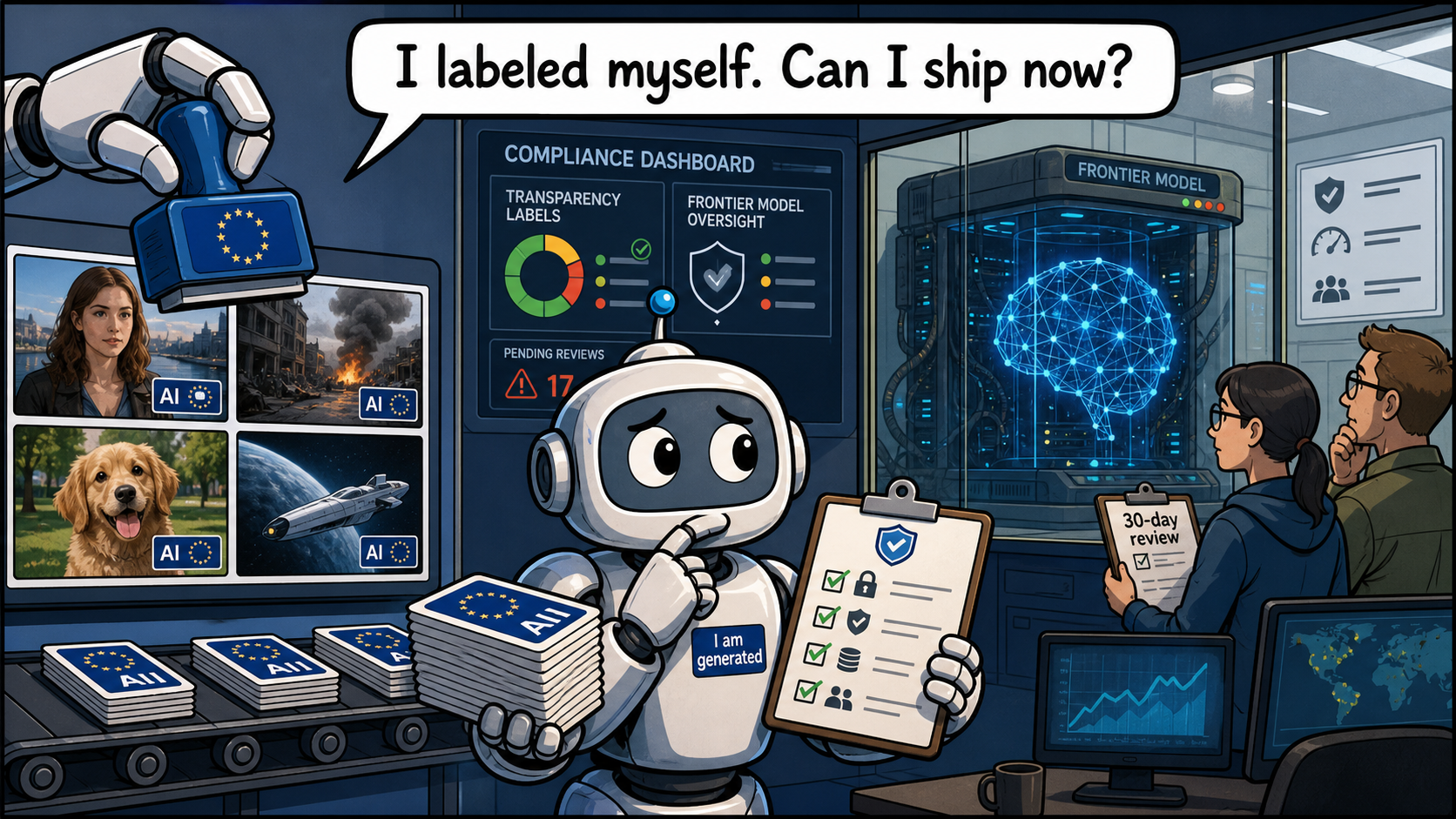
In Europe, the AI Act’s transparency obligations under Article 50 started to apply on August 2, 2026. The European Commission’s guidance says providers and deployers need practical ways to inform people when they interact with AI systems, mark synthetic content, disclose deepfakes, and handle other transparency duties in a consistent way.
In the United States, the White House’s June AI cybersecurity order points in a different direction: classified benchmarking, a voluntary framework for covered frontier models, and secure early access for trusted government partners. Axios reported this week that the draft framework being discussed with major AI companies includes a 30-day pre-release review path for advanced closed-source systems, while excluding open-source models from that process.
The common thread is not one global rulebook. It is the arrival of release-time governance.
What Happened
The European Commission published guidelines on July 20, 2026 to help authorities, providers, and deployers apply Article 50 of the AI Act. Those transparency obligations began applying on August 2, 2026.
Article 50 focuses on clear notice and disclosure. People should know when they are directly interacting with an AI system unless it is obvious. Providers of systems that generate synthetic audio, image, video, or text content must mark outputs in a machine-readable and detectable way where technically feasible. Deployers must disclose deepfakes, and AI-generated public-interest text has its own disclosure duties unless it has human review and editorial responsibility.
The U.S. track is more security-centered. A June 2 White House fact sheet says the administration ordered a classified benchmarking process for advanced AI cyber capabilities and a voluntary framework around covered frontier models. The executive order also says it should not be read as creating mandatory licensing, pre-clearance, or permitting for AI model release.
Axios reported on August 4 that the confidential framework discussed with AI companies would focus on advanced closed-source systems with potential national security implications and include a 30-day pre-release review period. Because that framework is not public, teams should treat the reported details as developing policy rather than settled law.
Why It Matters
For AI teams, transparency is no longer only a policy page or a trust-and-safety statement. It needs to show up inside release checklists, content pipelines, product UX, logging, vendor reviews, and incident response.
That shift matters because the duties sit at different layers.
Some are user-facing: labels, notices, disclosures, and explainable interaction points. Some are technical: machine-readable marks, detection robustness, cybersecurity benchmarks, and secure access procedures. Some are organizational: editorial responsibility, human review, model release governance, and records that show why a system was shipped.
The practical risk is fragmentation. A company may need EU-style transparency controls for a product surface, U.S.-style cyber review for a frontier model, and customer-specific evidence for enterprise procurement. None of that works well if governance is bolted on the day before launch.
Key Details
- EU Article 50 transparency obligations started applying on August 2, 2026.
- The European Commission’s guidance is meant to make those obligations consistent, effective, proportionate, and uniform.
- Article 50 covers AI interaction notices, synthetic-content marking, deepfake disclosure, and some AI-generated public-interest text disclosures.
- The U.S. June 2 executive order calls for classified benchmarking of advanced cyber capabilities in AI models.
- The same U.S. order calls for a voluntary framework with secure early access for trusted government partners around covered frontier models.
- Axios reported that the draft U.S. process under discussion includes a 30-day pre-release review for advanced closed-source systems and excludes open-source models.
- The U.S. order explicitly rejects mandatory model licensing or pre-clearance, which makes the practical effect of the voluntary framework worth watching.
Impact For Developers And Enterprises
For product teams, the near-term work is basic but unglamorous: know where AI outputs appear, decide which outputs need labels, make labels durable enough for downstream systems, and keep human-review evidence where editorial responsibility matters.
For model teams, release planning should include a separate security track. If a system could be treated as a frontier model with meaningful cyber capability, teams should expect more pre-release documentation, red-team evidence, access controls, and internal sign-off.
For enterprise buyers, this becomes vendor diligence. Useful questions include: how are AI-generated outputs marked, how are deepfake or public-interest uses handled, how are model cyber capabilities evaluated, and who can stop a release if the evidence is not ready?
Risks Or Limitations
The EU guidance is practical, but implementation will still be uneven. Machine-readable content marks need interoperability, user notices can become meaningless if overused, and cross-border products will need careful mapping between legal duties and product behavior.
The U.S. framework is even less settled in public. The official order establishes direction, but many operational details reported this week are not public. That makes it hard for smaller labs, open model developers, and enterprise customers to know exactly what process to expect.
The bigger risk is performative compliance. A label that nobody sees, a benchmark nobody can interpret, or a voluntary review nobody can audit may create paperwork without improving trust.
Final Take
AI oversight is moving from abstract principles into shipping infrastructure.
The winning teams will not treat transparency, cybersecurity review, and human accountability as separate legal chores. They will turn them into normal release controls: visible in the product, traceable in the logs, and understandable to the people who have to approve the launch.
The boring checklist is becoming the governance layer.
Sources
- “Guidelines on transparency obligations for providers and deployers of AI systems” - https://digital-strategy.ec.europa.eu/en/library/guidelines-transparency-obligations-providers-and-deployers-ai-systems
- “Article 50: Transparency obligations for providers and deployers of certain AI systems” - https://ai-act-service-desk.ec.europa.eu/en/ai-act/article-50
- “Fact Sheet: President Donald J. Trump Promotes Advanced Artificial Intelligence Innovation and Security” - https://www.whitehouse.gov/fact-sheets/2026/06/fact-sheet-president-donald-j-trump-promotes-advanced-artificial-intelligence-innovation-and-security/
- “Promoting Advanced Artificial Intelligence Innovation and Security” - https://www.whitehouse.gov/presidential-actions/2026/06/promoting-advanced-artificial-intelligence-innovation-and-security/
- “Scoop: Inside Trump’s AI framework” - https://www.axios.com/2026/08/04/inside-trump-ai-framework