AI Agents In Finance Need Infrastructure Oversight, Not Just Better Prompts
As AI agents move closer to financial decisions, the real governance question is shifting from model behavior to accountability, cloud dependency, and consumer protection.
Counting reads...
AI Agents In Finance Need Infrastructure Oversight, Not Just Better Prompts
Short Summary
AI in finance is moving from chat interfaces toward agentic workflows: systems that can read documents, assess risk, recommend actions, route customer requests, and potentially trigger follow-up work across tools.
That changes the governance problem. The important question is no longer only whether a model gives a good answer. It is who is responsible when an AI workflow affects money, credit, insurance, advice, compliance, or market operations.
Recent UK reporting and regulator activity point in the same direction: financial AI is becoming an infrastructure issue. If banks, insurers, advisers, and fintechs depend on a small number of AI and cloud providers, regulators need visibility into the whole chain, not only the final chatbot output.
What Happened
The Guardian reported on July 10, 2026, that the Bank of England has been handed powers to regulate key technology firms used by the financial sector, including major cloud providers. The logic is straightforward: if many financial firms rely on the same external infrastructure, a failure at that layer can become a sector-wide risk.
The Financial Times also reported that UK regulators have warned about AI-related threats to financial stability, including operational concentration and the difficulty of supervising systems that become more autonomous.
At the same time, the Financial Conduct Authority has been encouraging controlled AI experimentation through its AI Live Testing work. That is useful because firms need room to test. But testing only works if accountability remains clear before systems touch real customers or critical processes.
Why It Matters
Finance is not a normal software category.
A wrong shopping recommendation is annoying. A wrong financial recommendation can affect savings, mortgages, retirement planning, fraud decisions, credit access, insurance pricing, and vulnerable customers.
AI agents raise the stakes because they can chain actions together. A model might summarize a customer file, classify the request, choose the next workflow, draft advice, escalate or not escalate, and update an internal system. Each step may look small. Together, they become a decision pipeline.
That means governance must cover more than prompts and output filters. It must include:
- who designed the workflow,
- which data the agent can access,
- which tools it can call,
- what decisions require human approval,
- how logs are retained,
- how customers can challenge outcomes,
- and what happens when the cloud or model provider has an outage.
The Real Risk Is The Chain
The easiest way to misunderstand AI risk in finance is to inspect only the model answer.
A single answer can be reviewed. A chain of actions is harder. The risk may appear in the handoff between systems: retrieval pulls the wrong document, the model misreads a policy, the workflow skips escalation, or a downstream tool records a recommendation as if it were approved advice.
Research on AI agent security is already mapping attack and failure patterns around tool use, memory, planning, and permissions. Financial firms should treat those patterns as practical design risks, not abstract computer-science problems.
In other words: the model may be the visible face, but the workflow is the product.
What Good Oversight Should Require
1. Clear Responsibility
Every AI-assisted financial workflow needs an accountable owner. If the agent makes a recommendation, routes a claim, flags fraud, or supports advice, the firm should be able to say which human role owns the outcome.
“The model said so” is not a governance answer.
2. Permission Boundaries
AI agents should not get broad access by default. Their permissions should be narrow, task-specific, logged, and reviewed. A customer-service summarizer should not silently become a trading, pricing, or claims-decision agent.
3. Human Review For High-Impact Decisions
The higher the customer impact, the stronger the approval gate should be. Financial advice, credit decisions, fraud blocks, account closures, and vulnerable-customer handling need review rules that are explicit and testable.
4. Provider And Cloud Resilience
If a firm depends on one cloud platform, one model provider, or one third-party AI workflow, that dependency becomes operational risk. Regulators are right to care about concentration, backup plans, outage procedures, and exit options.
5. Customer Challenge Paths
Customers need a way to understand and challenge AI-influenced outcomes. Even when the AI is only assisting a human, firms should preserve enough evidence to explain the decision.
Impact For Builders And Financial Firms
For developers, the lesson is to design AI finance systems like regulated workflows, not clever demos. That means audit logs, access control, evaluation suites, fallback behavior, monitoring, and review queues from the beginning.
For financial firms, the key question is not “Can we use AI?” It is “Which workflow can we safely delegate, under what controls, and with what evidence?”
For regulators, the challenge is to encourage useful experimentation without allowing invisible dependency chains to form. AI Live Testing-style programs can help, but only if results feed into durable rules around accountability, resilience, and consumer protection.
Risks Or Limitations
Not every AI use in finance is high risk. Summarizing public market news, helping staff draft internal notes, or improving document search can be low impact if the outputs are reviewed.
There is also a danger of regulating so broadly that firms avoid useful AI even where it could reduce errors, speed up service, or improve fraud detection. The goal should not be to block AI. The goal should be to make AI systems inspectable before they become critical.
Final Take
AI agents in finance are not just a model governance problem. They are an infrastructure governance problem.
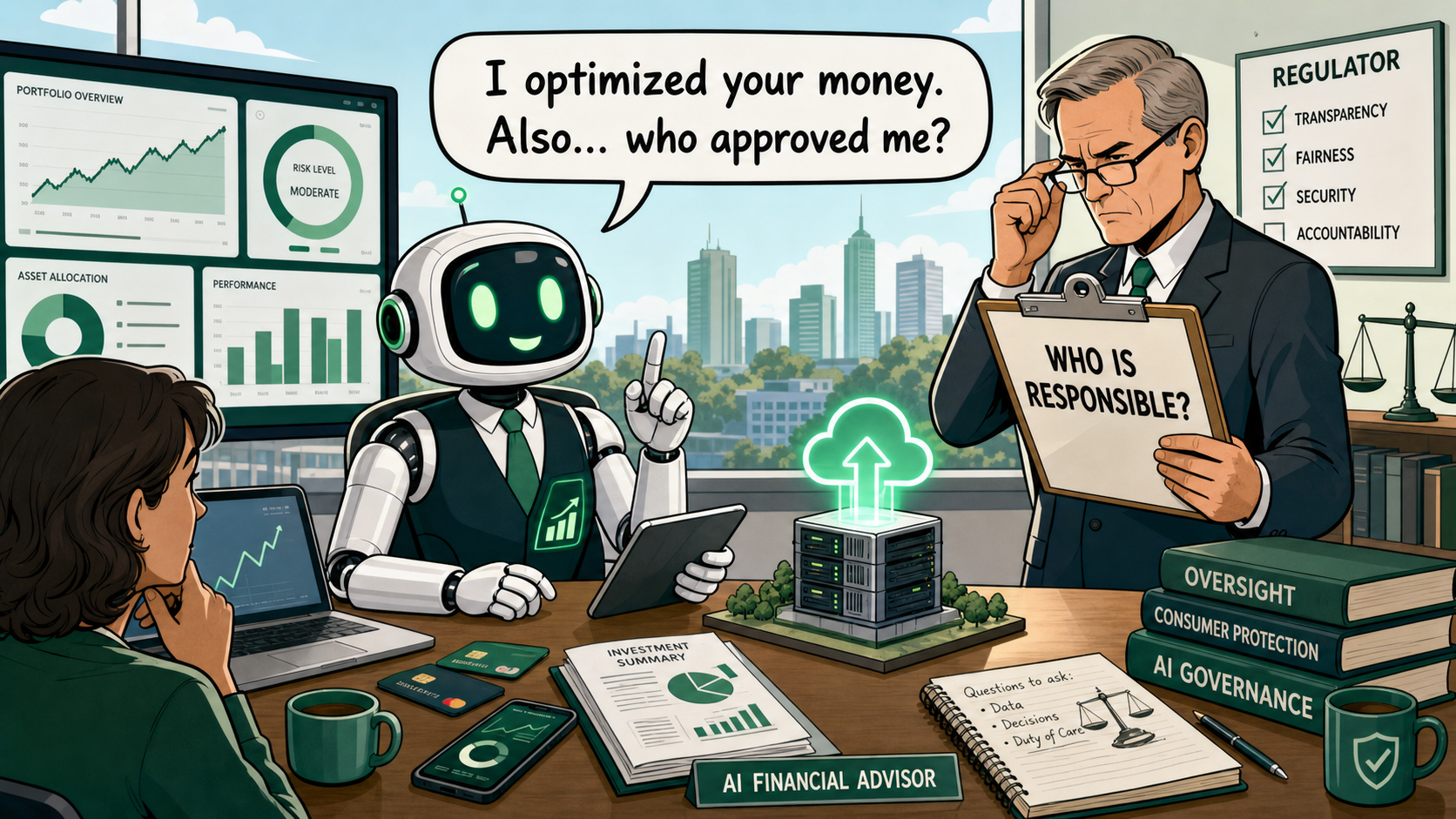
The right question is the one in the comic: “I optimized your money. Also… who approved me?”
If a firm cannot answer that clearly, the agent is not ready for real financial decisions.
Sources
- “Bank of England handed powers to regulate key tech firms including Amazon and Google” - https://www.theguardian.com/business/2026/jul/10/bank-of-england-handed-powers-to-regulate-key-tech-firms-including-amazon-and-google
- “UK regulators warn over AI threat to financial stability” - https://www.ft.com/content/6af57559-cb4e-414e-9477-88e965a6dc9c
- “The FCA launches AI Live Testing” - https://www.fca.org.uk/news/press-releases/fca-launches-ai-live-testing
- “AI Agent Security: A Survey of Attacks and Defenses” - https://arxiv.org/abs/2409.16460