AI Data Centers Need a Local License to Operate
The AI buildout is running into a political constraint: communities, utilities, and state governments now want proof that data centers pay their own way.
Counting reads...
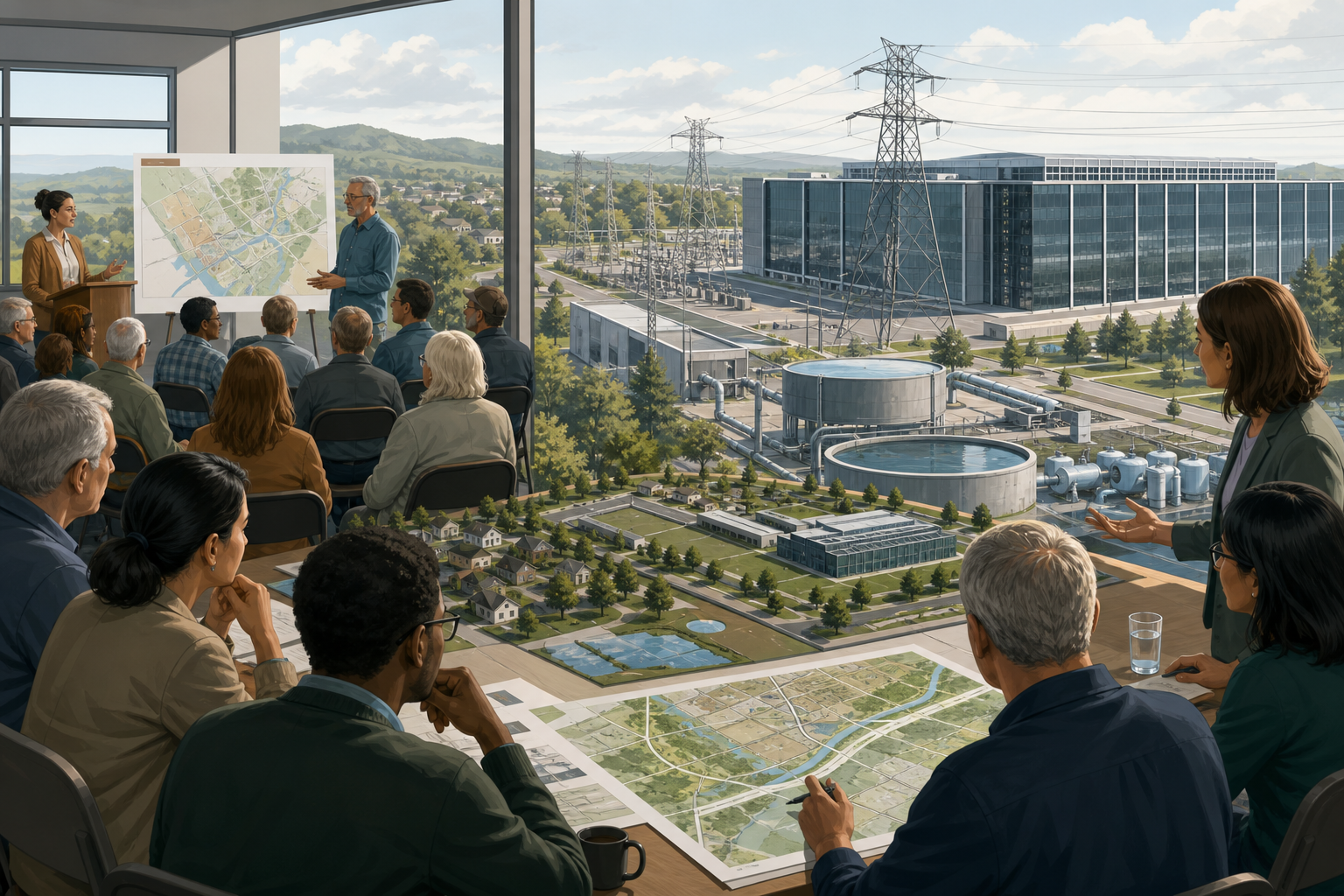
AI Data Centers Need a Local License to Operate
Short Summary
The AI infrastructure story is no longer only about chips, capital, and power contracts. It is also about permission.
The Wall Street Journal reported on August 19, 2026 that major AI and cloud companies are racing to answer growing public backlash against data-center projects. Associated Press reporting from August 18 described the same pressure entering governors’ races, with candidates and state officials responding to concerns about electricity costs, water use, noise, land use, and local control.
This matters because Gallup found in May that 71% of U.S. adults opposed building an AI data center in their local area, including 48% who were strongly opposed.
Compute is becoming a local politics problem.
What Happened
Several threads are converging at once.
First, data-center demand is rising because AI systems need large, power-hungry compute facilities. Second, communities are seeing the physical footprint: land acquisition, transmission upgrades, water needs, backup generators, traffic, and noise. Third, state governments are starting to translate public unease into permitting rules and ratepayer protections.
Pennsylvania’s GRID standards are a useful example. The program asks data-center developers seeking state support to address energy affordability, transparency and community engagement, workforce and economic development, and environmental protection. The standards require energy plans that avoid shifting costs to other ratepayers, public engagement, footprint reporting, job commitments, and ongoing compliance reporting.
At the federal level, the White House’s Ratepayer Protection Pledge says major AI companies and hyperscalers agreed to build, bring, or buy new generation resources and cover the delivery-infrastructure upgrades required for their data centers. Meta has also publicly backed Texas data-center standards, saying it pays the full costs of energy, water, wastewater, and grid infrastructure associated with its facilities.
The pattern is clear: AI infrastructure is moving from private capital planning into public accountability.
Why It Matters
For AI labs and cloud providers, data-center siting risk is now a strategic risk. A project can have financing, chips, and customers, but still fail if local officials or residents reject the terms.
That changes how AI infrastructure should be evaluated. The old question was: can the company get enough power? The new question is: can the company prove that the project will not leave the local community with hidden costs?
For enterprises buying AI services, this also matters. Infrastructure bottlenecks can affect model availability, pricing, latency, and vendor roadmaps. If a provider’s expansion plan depends on contested data-center sites, that is no longer an abstract policy issue. It can become a supply-chain issue.
The broader lesson is that “responsible AI” is not limited to model behavior. It now includes the power, water, land, workforce, and local governance needed to run the models.
Practical Impact
AI companies should treat community acceptance as part of deployment readiness.
That means publishing project-level energy and water plans early, not only broad sustainability claims. It means explaining who pays for grid upgrades, how demand will be matched with new generation, how water and cooling impacts are managed, and what the local tax and job benefits actually look like.
It also means giving communities real timing. If residents learn about a project only after land options, utility negotiations, and incentive packages are already mostly settled, backlash is predictable.
Enterprise AI teams should ask vendors a simpler version of the same question: where is the compute coming from, and how resilient is the expansion plan? The answer does not need to reveal every facility, but it should show whether the vendor has thought beyond GPU supply.
Watch Points
- Whether more states adopt Pennsylvania-style standards for energy affordability and community engagement.
- Whether ratepayer-protection pledges become enforceable utility rules or remain voluntary commitments.
- Whether AI companies disclose project-level water, power, and grid-upgrade obligations.
- Whether local opposition delays major AI compute projects enough to affect product roadmaps.
- Whether buyers start treating data-center siting and energy strategy as part of vendor risk review.
Final Take
AI companies can buy chips. They can raise capital. They can sign power contracts.
But the next constraint may be local permission. The companies that handle that well will not treat communities as an afterthought. They will make the costs, benefits, and operating commitments reviewable before the backlash hardens.
Sources
- “Inside Big Tech’s Frantic Race to Quell the Growing Backlash to AI” - https://www.wsj.com/tech/inside-big-techs-frantic-race-to-quell-the-growing-backlash-to-ai-2a717339
- “Governors’ races are being increasingly buffeted by the toxic politics of data centers” - https://apnews.com/article/f96176c2bcb76cbe8e823ed79fbdf196
- “Americans Oppose AI Data Centers in Their Area” - https://news.gallup.com/poll/709772/americans-oppose-data-centers-area.aspx
- “The Governor’s Responsible Infrastructure Development (GRID) Standards” - https://dced.pa.gov/business-assistance/data-center-resources/grid-standards/
- “Fact Sheet: President Donald J. Trump Advances Energy Affordability with the Ratepayer Protection Pledge” - https://www.whitehouse.gov/fact-sheets/2026/03/fact-sheet-president-donald-j-trump-advances-energy-affordability-with-the-ratepayer-protection-pledge/
- “Meta Upholds Texas Governor Greg Abbott’s Data Center Standards” - https://about.fb.com/news/2026/08/meta-upholds-texas-governor-greg-abbotts-data-center-standards/